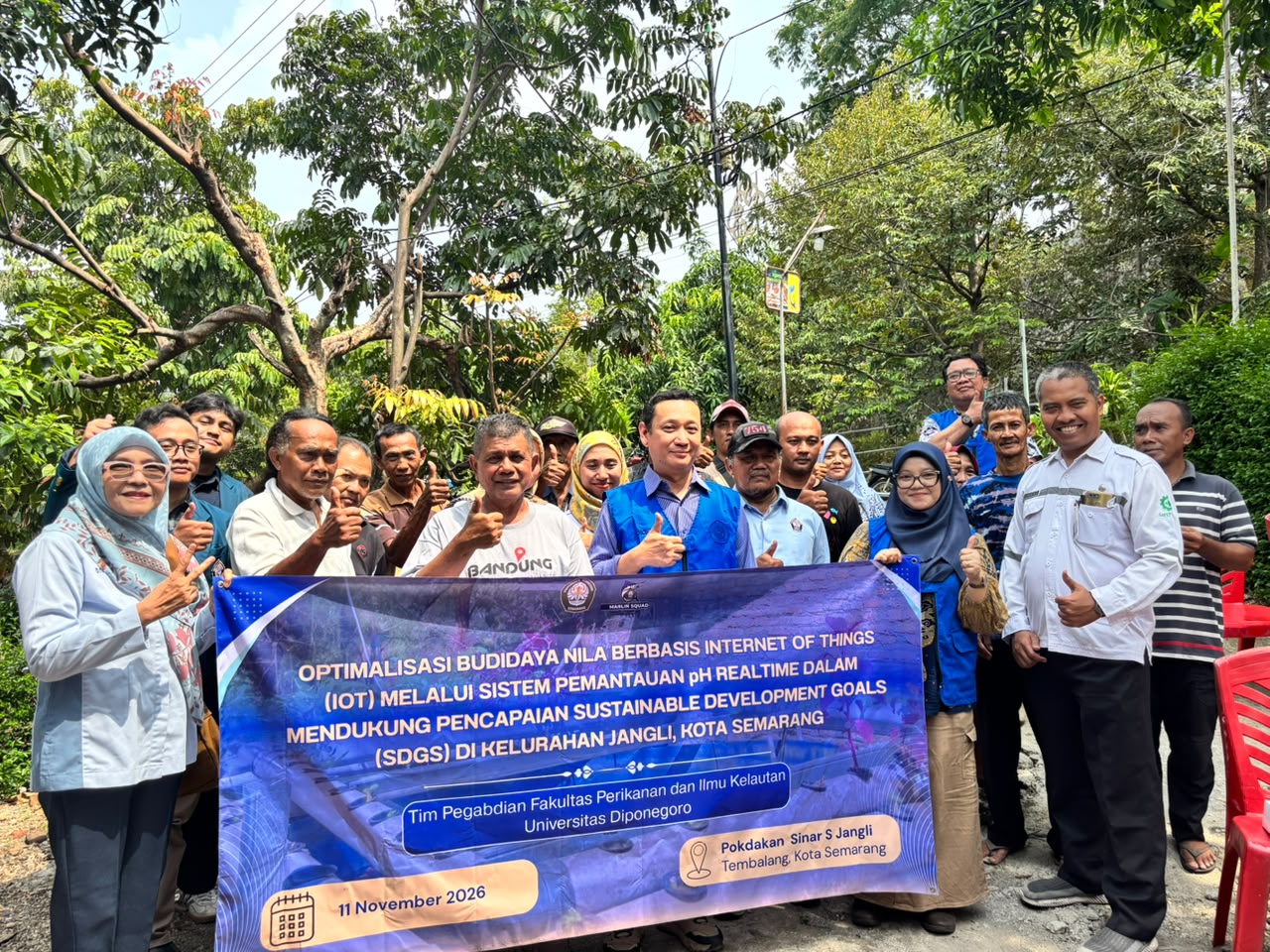
Semarang, Indonesia – Universitas Diponegoro (UNDIP), through the Community Service Team of the Aquaculture Study Program, Faculty of Fisheries and Marine Sciences (FPIK), has introduced Internet of Things (IoT) technology to improve tilapia farming in Jangli Village, Semarang. The program works with the Sinar S Fish Farmers Group to improve pond water quality management through digital technology.
The program receives funding from the FPIK UNDIP Community Service Grant. It carries the theme “Improving Tilapia Farming through an IoT-Based Real-Time pH Monitoring System to Support the Sustainable Development Goals (SDGs) in Jangli Village, Semarang.”
The program aims to solve a common problem among local fish farmers. They often find it difficult to check pond water quality regularly. In particular, they need to monitor water acidity, which is measured by pH levels. Stable pH levels help keep fish healthy and support their growth. As a result, good water quality can improve farming productivity.
IoT Technology Helps Farmers Monitor Water Quality
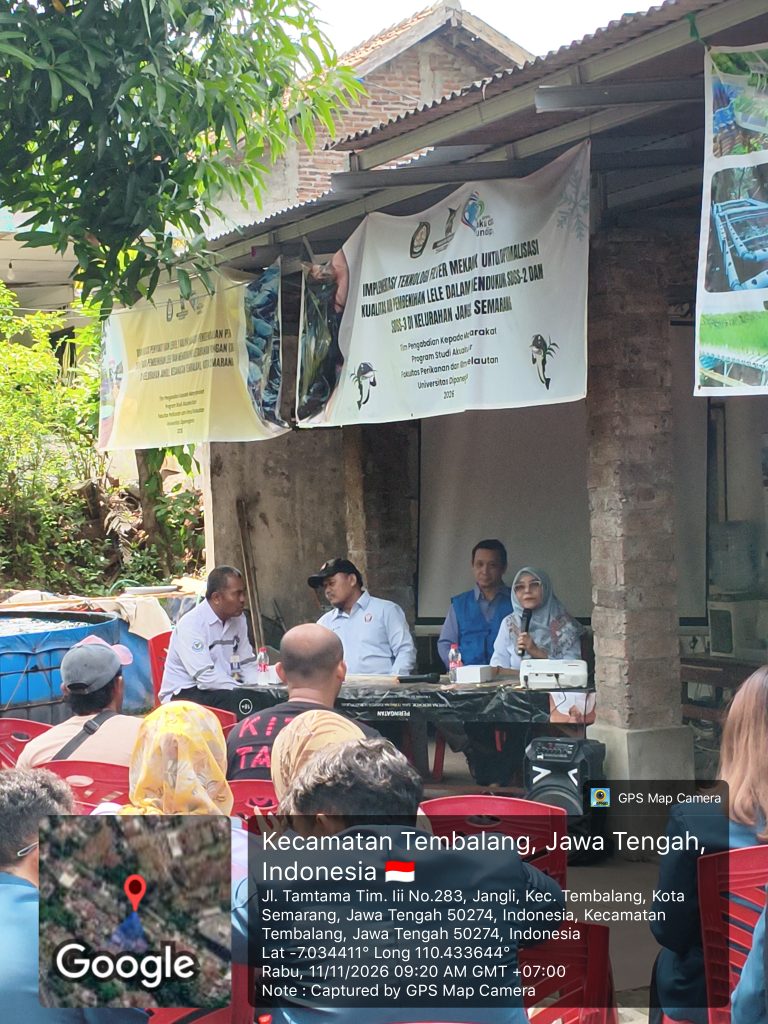
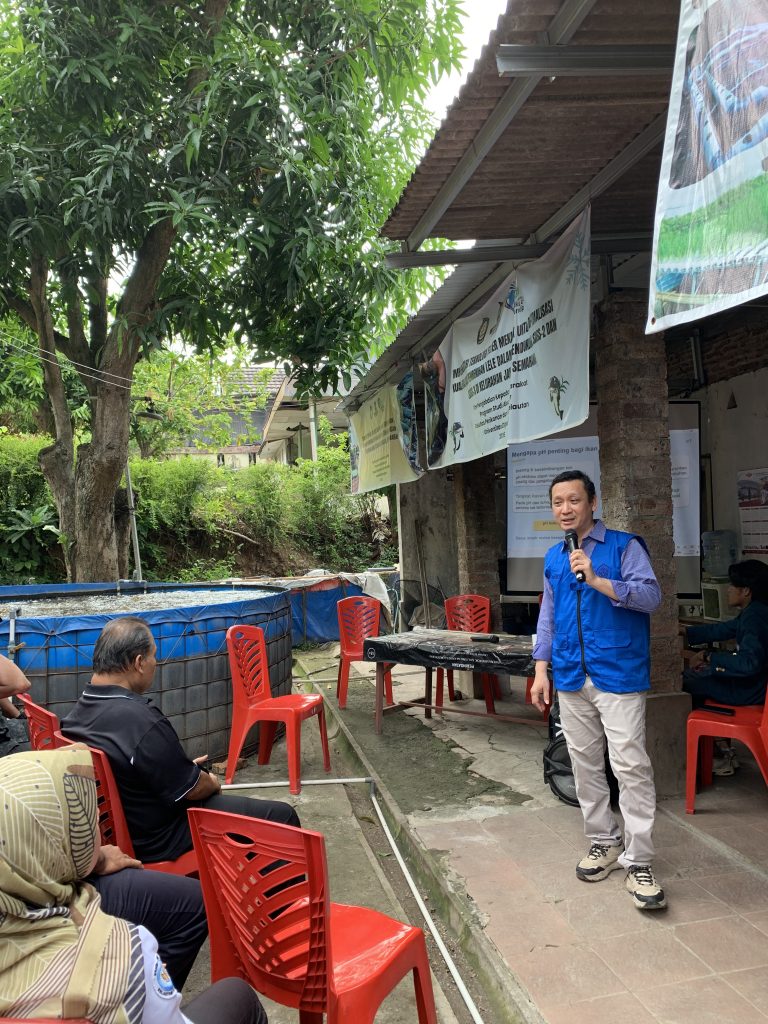
To address this problem, the team introduced an IoT-based pH monitoring device. They also held an educational session and handed over the device to the fish farmers.
The device allows farmers to check pond water pH levels in real time. Therefore, they can access water quality information more quickly. They can also use this information to decide when their ponds need attention.
In addition, the team explained why regular water quality checks are important. Through this activity, farmers can learn how to manage their ponds more effectively. They can also use digital tools to support their daily farming activities.
Lecturers and Students Work Together to Develop IoT Technology
Dicky Harwanto, S.Pi., M.Sc., Ph.D., leads the community service team. He specializes in Water Quality Management. Meanwhile, four other lecturers contribute their knowledge in different areas of aquaculture.
The team members include Prof. Dr. Ir. Sarjito, M.App.Sc., who specializes in Fish Health Management; Dr. Diana Chilmawati, S.Pi., M.Si., who focuses on Natural Feed; Dr. Ir. Diana Rachmawati, M.Si., who specializes in Fish Nutrition and Feed; and Ristiawan Agung N., S.Pi., M.Si., who focuses on Fish Reproduction and Genetics.
Furthermore, the program involves students from the Aquaculture Study Program. They are taking part in the Fisheries Extension course. The students include Ridwan M.R.N., Fitriana N.E., Hanitya C.W., Aulia A.P., Rabhadina A.R., Najjiya F.M., Kathlyn H.L., and Ririan N.A.
The team also works with two Electrical Engineering students from UNDIP, Zidan F. and M. Humam F. They help assemble the IoT monitoring device. This teamwork brings together knowledge of aquaculture and electrical engineering. As a result, the team can develop technology that meets the needs of local fish farmers.
UNDIP Hands Over IoT Monitoring Device to Sinar S Fish Farmers Group
The community service program started in August 2026. At that time, the team visited the Sinar S Fish Farmers Group to identify problems in their farming activities. After the visit, the team prepared the IoT device and developed materials for the educational session.
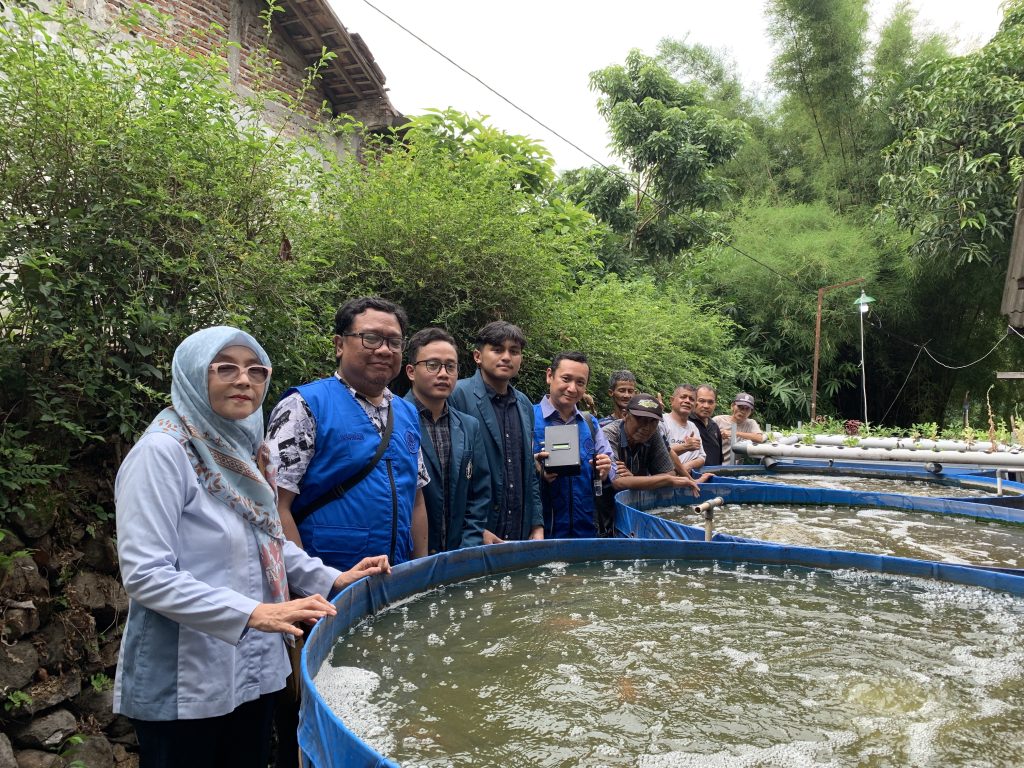
The main activity took place on Wednesday, November 11, 2026. The team held an educational session and handed over the IoT-based pH monitoring device to the Sinar S Fish Farmers Group.
The event brought together the Aquaculture community service team, students from the Fisheries Extension course, and Electrical Engineering students who helped develop the device.
Surya Hangesta, Chair of the Sinar S Fish Farmers Group, attended the event with other group members. In addition, Kuntoro Aji, S.Pi., from the Fisheries Extension Division of the Ministry of Marine Affairs and Fisheries, joined the event with his team.
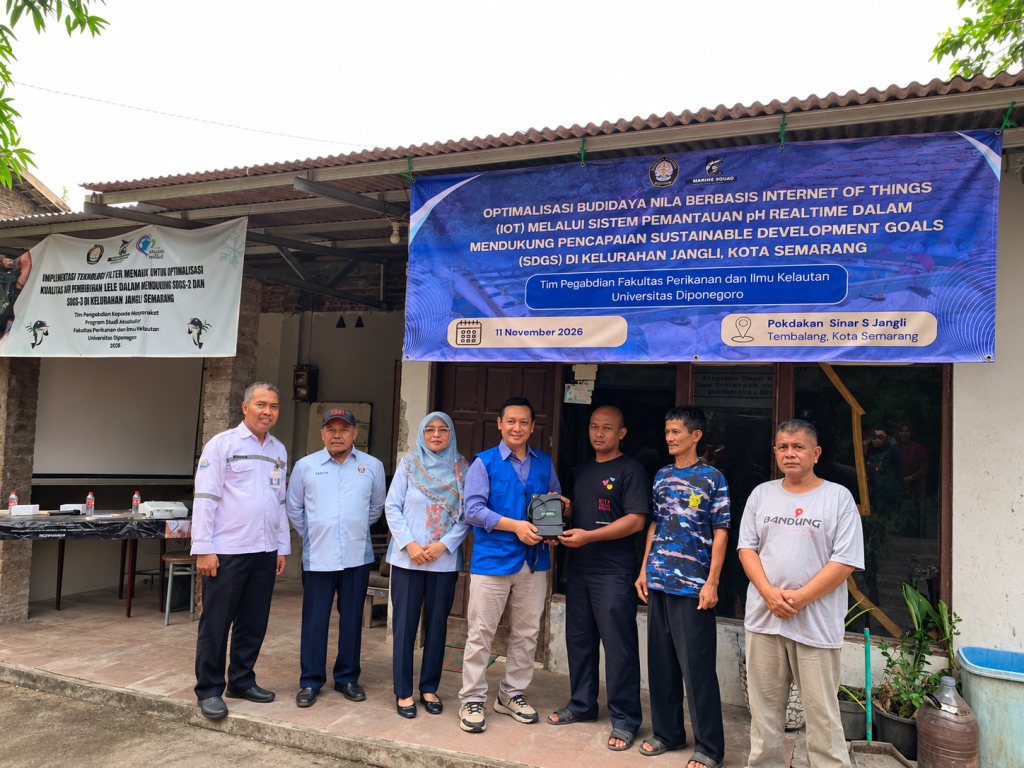
During the session, the team explained how to use the device to monitor pond water pH levels. They also shared information about the role of water quality in successful tilapia farming. Through this activity, farmers gained practical knowledge about using digital technology in their daily work.
Supporting Sustainable Tilapia Farming and the SDGs
The use of IoT technology in Jangli shows UNDIP’s commitment to supporting digital development in the fisheries sector. The program aims to improve farmers’ knowledge and skills in managing pond water quality.
Furthermore, this activity supports several Sustainable Development Goals (SDGs). First, it contributes to SDG 2 (Zero Hunger) by helping improve fish farming and food production. Second, it supports SDG 9 (Industry, Innovation, and Infrastructure) through the use of technology in aquaculture.
The program also supports SDG 12 (Responsible Consumption and Production). This goal encourages responsible use of natural resources and sustainable production practices.
Through this community service program, FPIK UNDIP continues to share knowledge and technology with local communities. Moreover, cooperation between lecturers, students, government representatives, and fish farmers can create practical solutions for the fisheries sector.
In the future, the team hopes that IoT technology will help farmers improve their pond management. Ultimately, this program aims to support more productive and sustainable tilapia farming in Jangli, Semarang.