
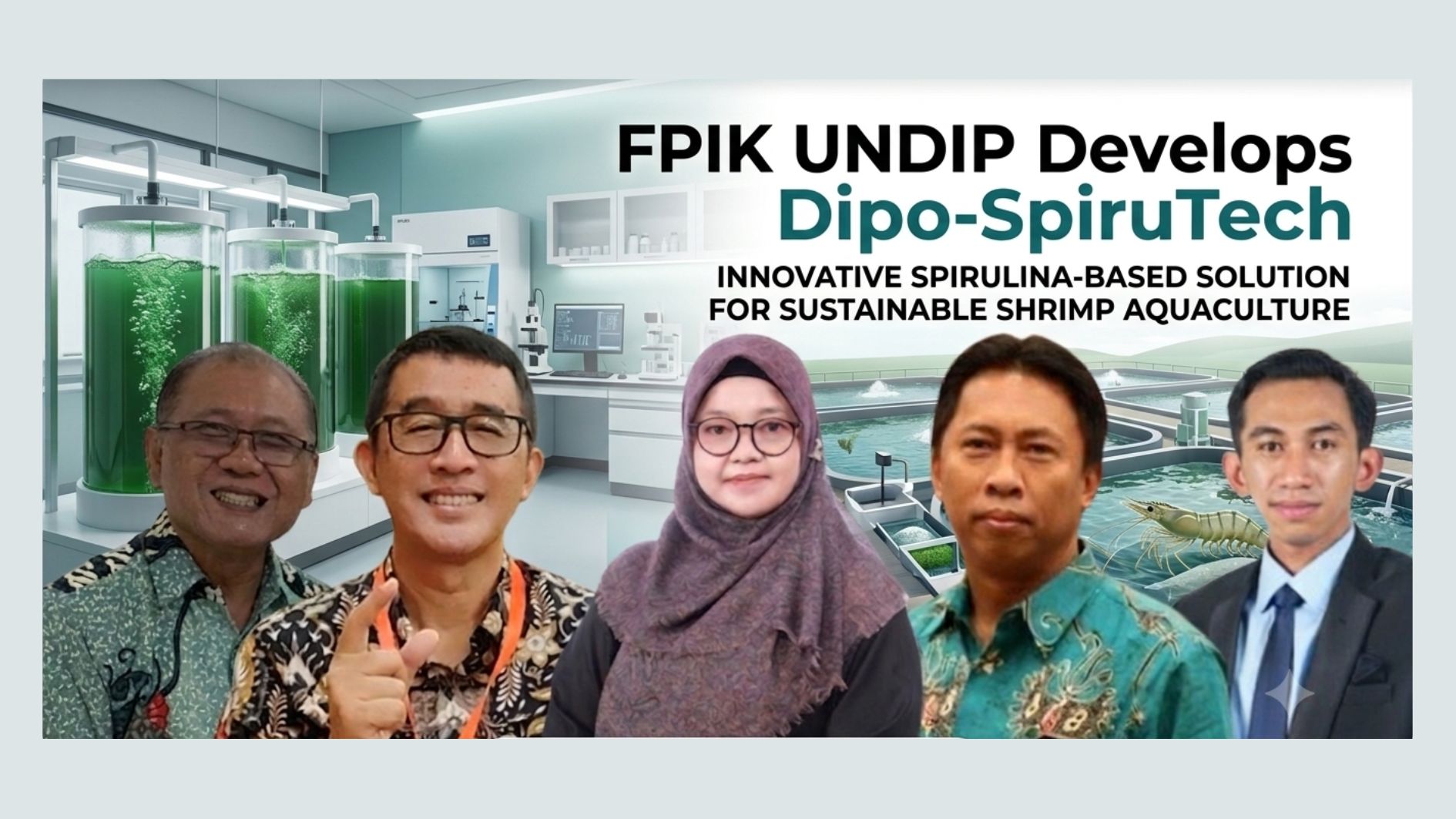
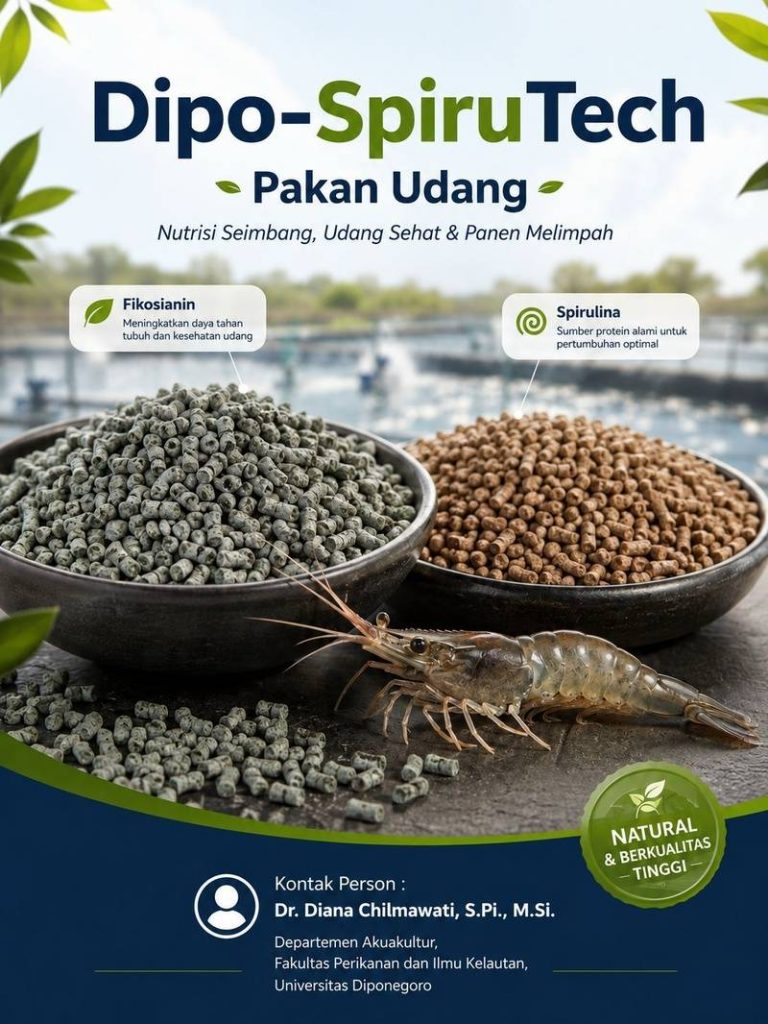
Semarang – A research team from the Department of Aquaculture, Faculty of Fisheries and Marine Sciences (FPIK), Universitas Diponegoro (UNDIP), has successfully developed and validated Dipo-SpiruTech, an innovative functional feed based on Spirulina platensis designed to enhance the resilience and productivity of Pacific white shrimp (Litopenaeus vannamei) farming. This innovation represents a strategic effort to support the sustainability of Indonesia’s shrimp aquaculture industry amid the challenges posed by climate change and the increasing threat of disease outbreaks.
The research, conducted throughout 2026, is part of UNDIP’s research downstreaming program aimed at advancing the Technology Readiness Level (TRL) from Level 6 to Level 7 through operational testing in intensive shrimp farming systems. The study was carried out at the Natural Feed Laboratory of FPIK UNDIP and at intensive shrimp ponds operated by the research partner, PT Ghana Utamadi Dhuniara.
The project was led by Dr. Diana Chilmawati, S.Pi., M.Si., together with a multidisciplinary research team comprising Prof. Dr. Ir. Dedi Jusadi, M.Sc., Prof. Dr. Ir. Nyoman Widiasa, S.T., M.T., Ir. Suminto, M.Sc., Ph.D., Pranata Candra Perdana Putra, S.Pi., M.Ling., and Dr. Asep Ridwanudin, S.Pi., M.Sc. Through interdisciplinary collaboration, the team developed an innovative feed formulation utilizing pure Spirulina platensis biomass and phycocyanin powder produced through patented cell-washing technology, complemented by various microalgae cultivation innovations resulting from continuous research.
The development of Dipo-SpiruTech was initiated in response to the growing global challenges facing the shrimp aquaculture industry, particularly climate change, which has caused fluctuations in temperature, salinity, and water quality. These environmental changes have significantly increased the risk of disease outbreaks, including Vibrio spp., Acute Hepatopancreatic Necrosis Disease (AHPND), and Infectious Myonecrosis Virus (IMNV), all of which are among the leading causes of high shrimp mortality in intensive farming systems.
The research was conducted through a comprehensive series of stages, beginning with the production of high-quality Spirulina biomass, followed by feed formulation with various Spirulina supplementation levels, laboratory testing, and field implementation in intensive shrimp ponds. Throughout the study, the research team monitored a range of production performance indicators, including growth, body weight, body length, Specific Growth Rate (SGR), Feed Conversion Ratio (FCR), and Survival Rate (SR), to evaluate the effectiveness of the developed functional feed.
The innovation is expected not only to provide an alternative functional feed derived from locally available resources but also to improve shrimp production efficiency, enhance growth performance, strengthen disease resistance, and reduce mortality rates by approximately 20 percent. Ultimately, Dipo-SpiruTech is expected to enhance the competitiveness of Indonesia’s aquaculture sector while reducing dependence on imported feed ingredients.
Through the development of Dipo-SpiruTech, FPIK Undip once again demonstrates its commitment to producing research-based innovations with tangible benefits for society. This achievement highlights the faculty’s significant contribution to strengthening national food security, supporting the sustainable development of Indonesia’s shrimp aquaculture industry, and accelerating the downstream utilization of research outcomes for broader applications in the fisheries and marine sectors.