Semarang – The Faculty of Fisheries and Marine Sciences (FPIK) at Diponegoro University has once again demonstrated its commitment to supporting the internationalization of education through student participation in the World Class University Students Go International (WCU SGI) Research Exchange program at Universiti Malaysia Sabah. This program provides a platform for students to gain academic and research experience in an international setting while broadening their global perspective in the fields of marine sciences and fisheries.
The WCU SGI program is a strategic initiative of Diponegoro University aimed at enhancing student competencies through international collaboration. As part of this program, students from the Department of Marine Sciences at Undip’s Faculty of Fisheries and Marine Sciences (FPIK)—Khansa Faizah Azzura and Bunga Calista—participated in various academic, research, and field activities at the Borneo Marine Research Institute (IPMB) at Universiti Malaysia Sabah, which focuses on marine science, fisheries, and coastal resources. This research exchange program took place over nearly three months, from March 16, 2026, to June 11, 2026.
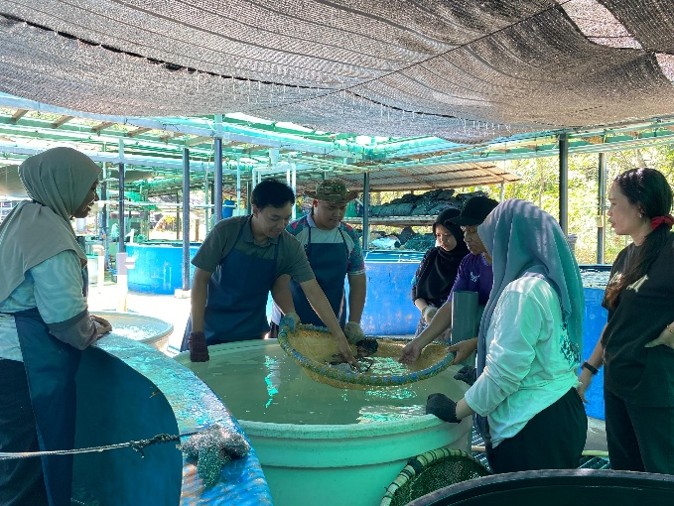
The research exchange program took place in Kota Kinabalu and Semporna, Sabah, Malaysia. The students were directly involved in various research and aquaculture activities, ranging from fish hatchery management and fish larvae rearing to seaweed cultivation. At the IPMB hatchery, participants managed B-Tanks for the rearing of Napoleon wrasse (Cheilinus undulatus) and tiger grouper–giant grouper hybrids by feeding the fish, transferring them, and cleaning the pond bottoms. In addition, the students also learned about rotifer management using Nannochloropsis sp. as natural feed for grouper larvae.
In addition, research activities were conducted in the seaweed cultivation area in Semporna, where samples of Kappaphycus alvarezii and Kappaphycus striatus were collected using the long-line method. Sampling was conducted randomly to obtain representative data on seaweed culture growth. The students also visited a floating house owned by a seaweed farmer, which serves as both a drying facility for the harvest and a site for collecting economically valuable salt deposits.
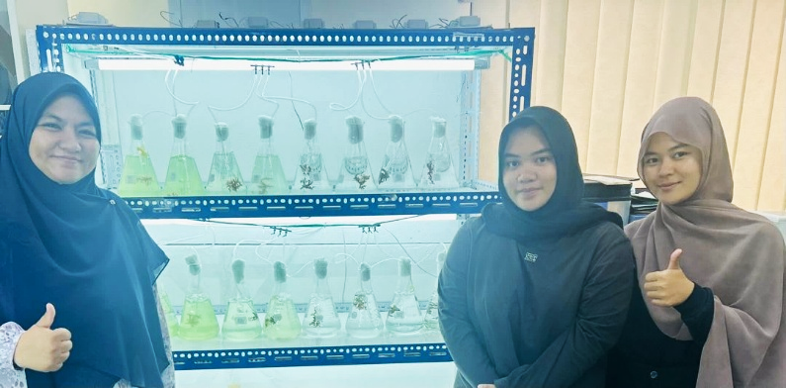
As part of the research, the students carried out preparatory steps, including sterilizing equipment and seawater, preparing culture media, and setting up the aeration system in the culture flasks. The research was titled “The Toxicity Effects of NPK Fertilizer on the Growth of Kappaphycus alvarezii and Kappaphycus striatus through Vegetative Propagation Using the Thallus Cutting Technique.” This study aimed to determine the effect of NPK fertilizer concentration on the growth of both seaweed species in a closed culture system, with monitoring conducted over a 15-day period.
Through this program, FPIK Undip students not only gain international research experience but also enhance their academic abilities, research skills, and cross-cultural competencies—all of which are essential for addressing global challenges in the fields of marine sciences and fisheries. The WCU SGI program is expected to continue strengthening international networks and improving the quality of FPIK Undip graduates on a global scale.