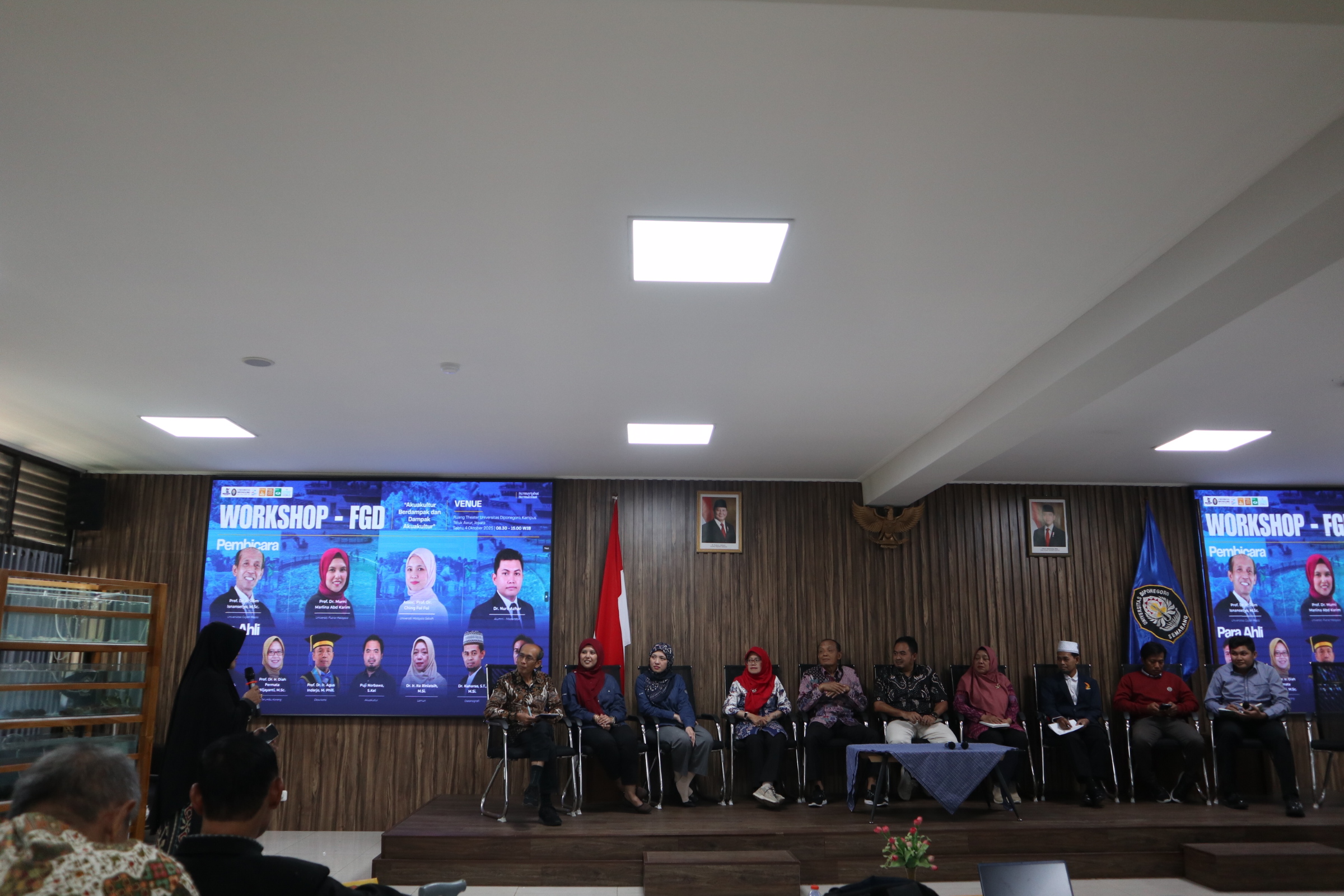
Jepara, October 4, 2025 – The Faculty of Fisheries and Marine Sciences (FPIK), Universitas Diponegoro (UNDIP), brought together experts from Indonesia and abroad for a workshop and Focus Group Discussion (FGD) on “Impactful Aquaculture and the Impacts of Aquaculture.” Held at the Theater Room, UNDIP’s Teluk Awur Campus in Jepara, the event explored pathways toward more sustainable aquaculture through collaboration among academia, industry, and local communities.
The workshop and FGD provided a platform for experts and stakeholders to discuss emerging challenges, technological innovations, policy directions, and strategies for developing an aquaculture sector that delivers meaningful economic, social, and environmental benefits.
Strengthening Policy and the Future of Aquaculture
The first session featured Prof. Alim Isnansetyo from Universitas Gadjah Mada, who discussed the concept of Impact-Oriented DIKTISAINTEK, highlighting the importance of cross-sector collaboration in higher education, research, and aquaculture innovation.
Prof. Alim emphasized the need to improve research quality, strengthen supporting infrastructure, and establish policies that support sustainable aquaculture development.
“The aquaculture sector must be able to deliver tangible social, economic, and ecological impacts,” he emphasized.
Advancing Innovation and Good Aquaculture Practices
Prof. Murni Marlina Abd. Karim from Universiti Putra Malaysia addressed several major challenges facing the aquaculture industry, including disease outbreaks, pollution, and excessive antibiotic use.
She highlighted the importance of implementing Good Aquaculture Practices (GAP) alongside technological innovations such as biofloc systems, probiotics, Recirculating Aquaculture Systems (RAS), and aquaponics.
According to Prof. Murni, these approaches can improve production efficiency while maintaining water quality and supporting the principles of a circular economy.
Breeding Technology for a More Resilient Aquaculture Industry
Assoc. Prof. Ching Fui Fui from Universiti Malaysia Sabah highlighted the critical role of breeding technology in strengthening the aquaculture industry.
Innovations in broodstock selection, hatchery management, and disease resistance can contribute to the production of high-quality seedstock while helping balance the economic, social, and ecological dimensions of aquaculture development.
Integrated Multi-Trophic Aquaculture for Sustainable Production
The workshop also explored Integrated Multi-Trophic Aquaculture (IMTA) as a potential pathway toward more sustainable production systems.
Dr. Nuril Azhar presented IMTA as an approach that integrates multiple aquatic organisms from different trophic levels within a single production system. By optimizing the use of space and nutrient flows, IMTA can help reduce waste through the complementary roles of filter-feeding organisms and macroalgae.
The approach demonstrates how integrated production systems can contribute to more efficient resource use while reducing the environmental impacts of aquaculture activities.
Expert Dialogue and FGD Outcomes
The FGD brought together experts with diverse backgrounds, including shrimp aquaculture, coral ecosystems, ecotourism, the aquaculture industry, oceanography, and seagrass ecology.
The discussions highlighted the importance of strengthening technological literacy, promoting sustainable ecosystem management, and developing stronger partnerships between academia and industry. Such collaboration is considered essential for accelerating the translation and commercialization of research-based innovations in aquaculture.
Through the workshop and FGD, FPIK UNDIP reaffirmed its commitment to advancing an aquaculture sector that goes beyond productivity to deliver positive and measurable impacts for society and the environment.
By bringing together researchers, industry practitioners, and stakeholders, the forum provided a foundation for continued collaboration in developing innovative, responsible, and sustainable aquaculture practices for the future.