
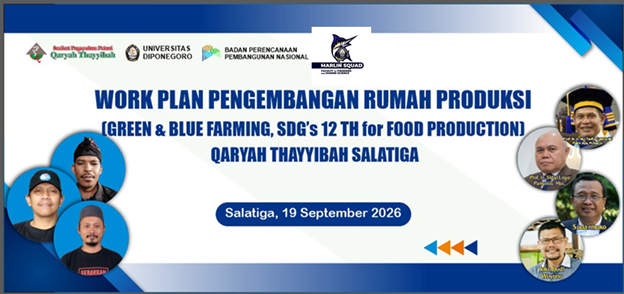
Salatiga, Indonesia – The Faculty of Fisheries and Marine Sciences (FPIK), Universitas Diponegoro (UNDIP), continues to strengthen its commitment to community empowerment through a community engagement program entitled “Work Plan for the Development of the Qoryah Toyyibah Production House: Green and Blue Farming for SDG 12 on Responsible Food Production.” The program was held on Saturday, September 19, 2026, at the Secretariat Hall of the Serikat Paguyuban Petani Qoryah Toyyibah (SPPQT) in Kalibening, Salatiga.
The program is part of a series of community engagement activities initiated by FPIK UNDIP in 2025. The initiative aims to strengthen community self-reliance by developing local agricultural, livestock, and fisheries resources through the principles of green and blue farming, while contributing to the achievement of the United Nations Sustainable Development Goals (SDGs), particularly SDG 12 on Responsible Consumption and Production.
The initial phase in 2025 focused on providing the community with fundamental knowledge of business feasibility and the application of Hazard Analysis and Critical Control Point (HACCP) principles. The training introduced safe and environmentally responsible food production practices as a foundation for developing community-based businesses.
In early 2026, the program entered its second phase through an advanced feasibility study and the preparation of business planning documents. A series of workshops conducted from March to May 2026 identified several potential flagship products for development as community-based start-ups.
The products included an integrated farming system involving Gama Umami grass and milk production, low-glycemic-index (LGI) liquid sugar, empon-empon herbal products, and Nile tilapia (Oreochromis niloticus). The initiative was subsequently expanded to include parboiled rice and coco mesh, both of which offer opportunities for economic development while addressing environmental considerations.
Following the preparation of the business plans, the program proceeded to the development of detailed work plans in September 2026. This stage was designed to translate business concepts into concrete implementation steps, measurable targets, resource requirements, and development strategies.
The September 19 activity was attended by Prof. Ambariyanto, representing Universitas Diponegoro, and Prof. Ir. Sidqi Lego Pangesti, M.Sc., representing the National Development Planning Agency of the Republic of Indonesia (Bappenas). The FPIK UNDIP community engagement team was led by Prof. Nur Taufiq, with the involvement of Dr. Ir. Suryono, M.Sc., and other members of the team.
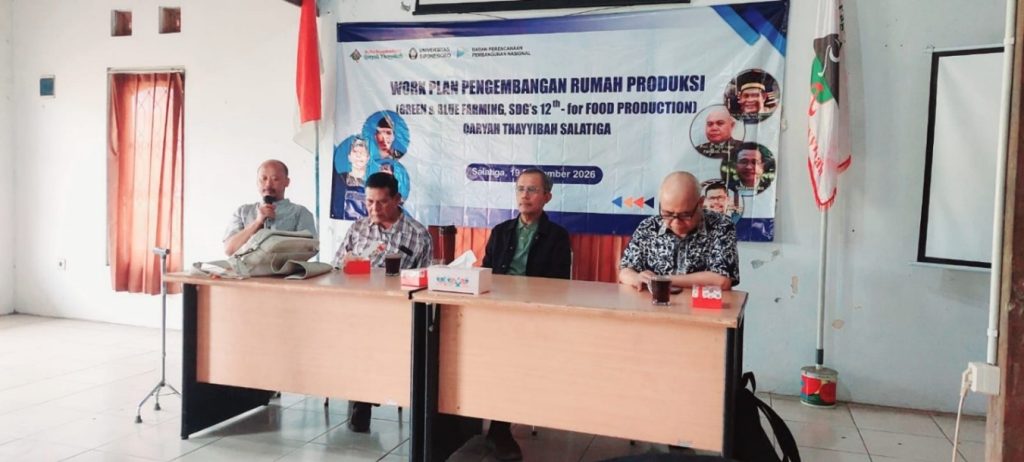
During the program, Prof. Ambariyanto highlighted the implementation of the SDGs within the UNDIP environment. Meanwhile, Prof. Sidqi Lego Pangesti and Dr. Suryono contributed perspectives on development planning and business documentation to support the systematic implementation of the Qoryah Toyyibah Production House.
According to Prof. Nur Taufiq, the community engagement program is intended to ensure that the business plans developed during previous activities can be translated into practical and measurable work plans.
“The mentoring process is designed to ensure that the business planning does not stop at the preparation of documents, but continues into concrete work plans with clear implementation stages and measurable targets,” he said.
Developing Products Based on Local Potential
SPPQT is an organization committed to empowering rural communities through the sustainable utilization of local potential. As part of this mission, SPPQT has established the Qoryah Toyyibah Learning Groups (KBQT), which serve not only as community-based educational institutions but also as platforms for developing businesses based on agricultural, livestock, and fisheries resources.
This potential provides an important avenue for collaboration with FPIK UNDIP. Through its academic expertise and experience in business feasibility studies, the faculty supports the community in developing viable and sustainable food production models.
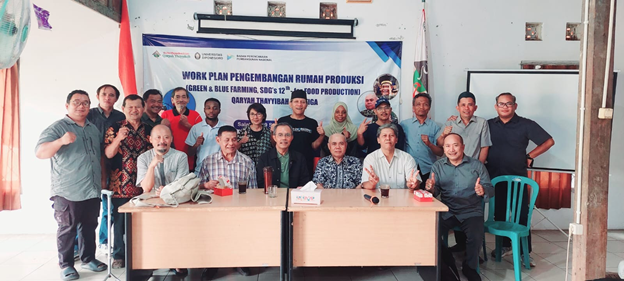
One of the key initiatives is the development of an integrated farming system that combines agricultural and livestock activities to maximize resource efficiency and sustainability.
The integrated farming roadmap consists of four major components: quality feed production, silage production, livestock production, and value-added products and energy. The system integrates Gama Umami grass cultivation, silage production, dairy farming, milk production, marketing, and continuous business development.
FPIK UNDIP and SPPQT have also developed a work plan for establishing an LGI liquid sugar production facility. The plan covers land acquisition and the master plan, process-flow visualization from raw materials to finished products, major machinery and utilities, investment planning, sugarcane supply-chain management, market organization and off-takers, as well as financial planning.
Another product being developed is parboiled rice. This processing innovation is intended to produce rice with improved nutritional characteristics compared with conventionally processed rice. During the parboiling process, some nutrients from the rice bran layer are transferred into the rice grain.
Parboiled rice also has a higher proportion of resistant starch and produces firmer grains that are less likely to break during milling. After cooking, the rice generally has a more separated and less sticky texture. The development of this product represents an effort to diversify food products while providing additional nutritional value.
Meanwhile, the development of empon-empon and Nile tilapia (Oreochromis niloticus) remains at the experimental stage. Production trials are being conducted by considering seasonal conditions, appropriate technologies, and economic feasibility to identify the most suitable production models.
Creating Opportunities for International Collaboration
The September 19 community engagement program also provided an opportunity to introduce international students from Tanzania studying at FPIK UNDIP to members of the Qoryah Toyyibah farming community.
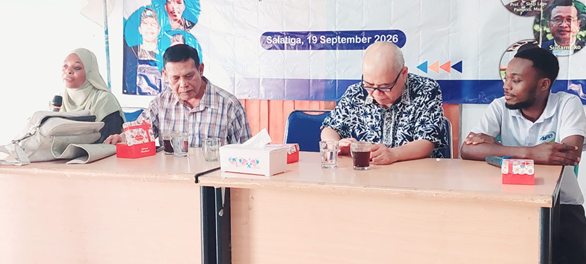
Two Tanzanian students, Aminna and Makongo, were introduced to the local farmers as part of their international learning experience. The interaction also opened opportunities for knowledge exchange and potential future collaboration between Indonesian and Tanzanian farming communities in developing green and blue farming initiatives.
In addition to the existing product development programs, SPPQT members from North Halmahera have proposed collaboration in developing coco mesh. The initiative seeks to transform coconut-based materials that may otherwise become environmental waste into products with economic and ecological value.
Advancing SDG 12 through Sustainable Food Production
The development of the Qoryah Toyyibah Production House is aligned with SDG 12: Responsible Consumption and Production. The program promotes more efficient resource utilization, reduction of food waste, environmentally responsible waste management, and the application of the principles of reduce, reuse, and recycle.
The initiative also emphasizes education and awareness by strengthening community understanding of sustainable production and consumption practices and promoting lifestyles that are more closely aligned with environmental sustainability.
Moving forward, FPIK UNDIP and SPPQT will continue to identify, evaluate, and refine each stage of product development. These efforts include strengthening collaboration with the Government of Central Java and exploring potential investment partnerships with various institutions, including Perbanas and Agrinas.
Through sustained academic and community collaboration, the Qoryah Toyyibah Production House is expected to develop into a community-based model that integrates agriculture, livestock, fisheries, economic development, and environmental sustainability.
The initiative demonstrates how higher education institutions can translate academic knowledge and expertise into practical community development, transforming the principles of green and blue farming into concrete business activities and products that generate both economic and ecological value.