
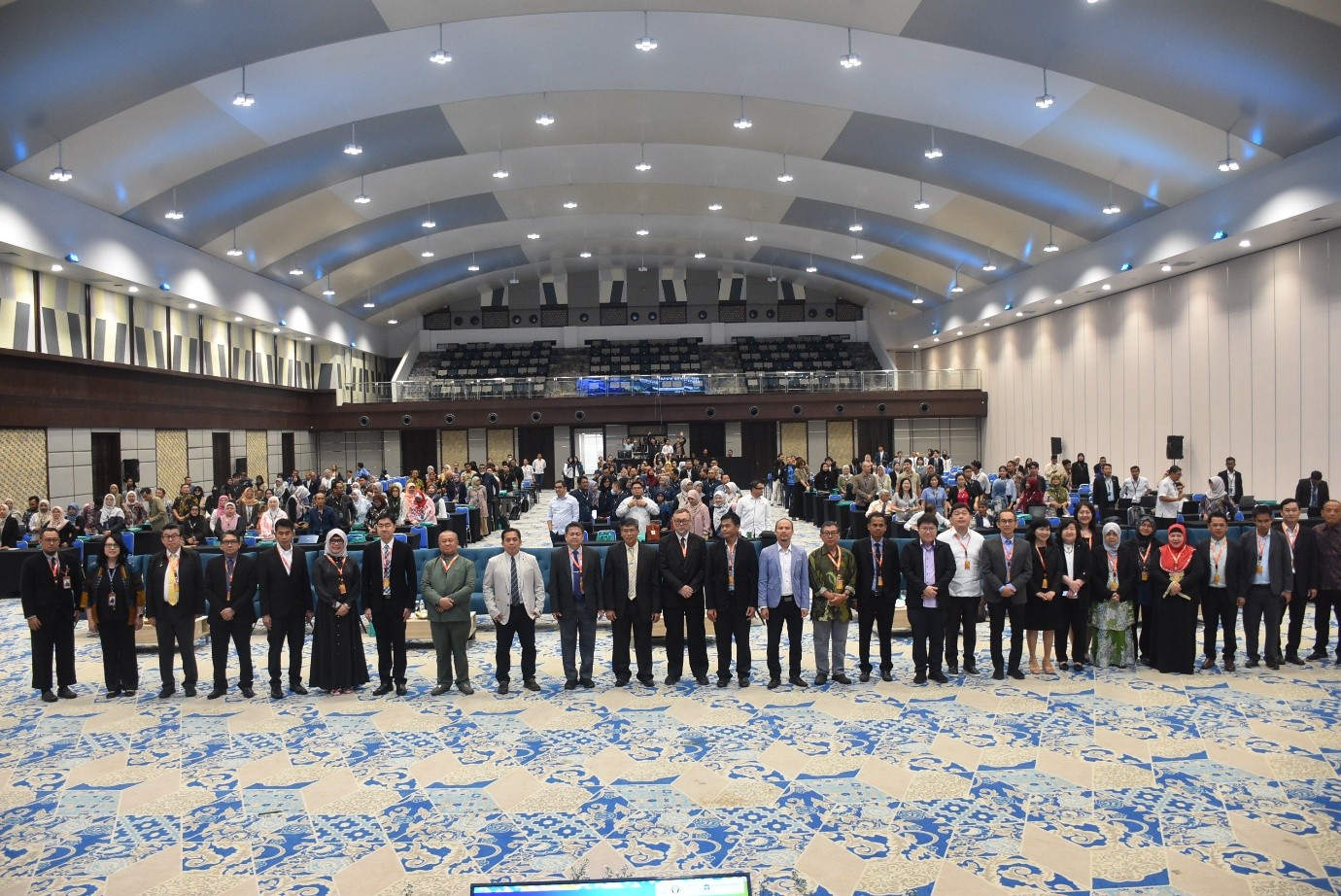
Semarang, Indonesia (09/10) — Hundreds of fisheries and marine science experts from across ASEAN and beyond gathered at Muladi Dome, Universitas Diponegoro (UNDIP), for the 13th International Fisheries Symposium (IFS 2025) and the 21st Annual Scientific Meeting of the Indonesian Association of Oceanologists (PIT ISOI 2025).
Held from October 6–9, 2025, the joint international event brought together academics, researchers, policymakers, and marine professionals to discuss pressing issues surrounding sustainable fisheries, marine resources, climate change, food security, and the blue economy.
The event featured two major themes: “ASEAN Fisheries and Marine Resources for Global Sustainability” and “The Strategic Role of ISOI in Achieving Food Security from the Sea and Land.” The symposium was organized through collaboration between the Faculty of Fisheries and Marine Sciences (FPIK) UNDIP, ASEAN Fisheries Education Network (ASEAN-FEN), and the Indonesian Association of Oceanologists (ISOI).
The symposium opened with remarks by Dr. Wiwiet Teguh Taufani, S.Pi., M.Si., Ph.D., Chair of the IFS 2025 Committee, who emphasized the importance of regional collaboration in addressing the growing challenges facing marine sustainability.
“Our collective efforts as scientists and policymakers will shape the future of ASEAN fisheries. Through this forum, we hope to create pathways that integrate research, innovation, and community action toward sustainable oceans,” Dr. Wiwiet said.
Following the opening remarks, Prof. Ir. Mochammad Amin Alamsjah, M.Si., Ph.D., Chair of ASEAN-FEN, welcomed participants and highlighted the importance of continued collaboration among ASEAN-FEN member universities.
He encouraged stronger and more sustainable academic partnerships to unlock the region’s blue economy potential.
“This gathering demonstrates that ASEAN can take a leading role in sustainable fisheries management when science meets shared commitment,” Prof. Amin stated.
The symposium was officially opened by Prof. Agus Trianto, S.T., M.Sc., Ph.D., Dean of FPIK UNDIP, who underscored the strategic role of academia in driving innovation in marine research and technology.
Day One: Advancing Sustainable Fisheries Management
The first keynote session on October 7 featured three international experts who shared perspectives on the future of fisheries management and marine sustainability in Southeast Asia.
Prof. Matsuishi Takashi Fritz, Ph.D., from Hokkaido University, Japan, opened the session with a presentation entitled “From Growth to Sustainability: The Future of Capture Fisheries in Southeast Asia.” He highlighted the growing pressure on coastal fisheries across Southeast Asia and called for a transition from expansion-driven fisheries toward more sustainable and science-based management approaches.
Dr. Pavarot Noranarttragoon of Thailand’s Department of Fisheries subsequently presented “New Approaches to Assessing and Managing the Multispecies Fishery in the Gulf of Thailand.” He discussed Thailand’s progress in implementing science-based fisheries policies, including dynamic multispecies yield models and fishing-effort controls, to support fish-stock recovery and address illegal, unreported, and unregulated (IUU) fishing.
The session concluded with Assoc. Prof. Ts. Dr. Noor Faizul Hadry Nordin of International Islamic University Malaysia, who presented “The Empowerment of Community-Driven Stewardship for Sustainable ASEAN Marine Resources.” Drawing on successful initiatives in the Philippines and Indonesia, he emphasized that long-term sustainability requires meaningful local participation, recognition of customary practices, and hybrid approaches to collaborative resource management.
Day Two: Climate, Energy, Innovation, and Marine Policy
On October 8, discussions expanded to the future of marine science, climate action, renewable energy, and the development of the blue economy, featuring five international keynote speakers.
Dr. Agus Santoso of the University of New South Wales, Australia, presented research on Indo-Pacific Climate Variability and Change, highlighting the increasing influence of climate phenomena such as El Niño and the Indian Ocean Dipole on regional fisheries and coastal livelihoods.
Meanwhile, Dr. R. Dwi Susanto of the University of Maryland, USA, explored the potential of marine renewable energy in supporting national energy independence. In his presentation, “The Role of ISOI in Achieving Energy Independence from the Sea,” he highlighted Indonesia’s substantial ocean-current energy potential and its prospects for sustainable electricity generation.
Prof. Ocky Karna Radjasa of the National Research and Innovation Agency (BRIN) shared his vision of strengthening the connection between research, innovation, and marine-based food security. He highlighted Indonesia’s exceptional marine biodiversity and BRIN’s research priorities in seaweed biotechnology and marine-based bioindustries.
The symposium also featured a keynote address by H.E. Sakti Wahyu Trenggono, Minister of Marine Affairs and Fisheries of the Republic of Indonesia, entitled “Realizing Food Security from the Sea and Coastal Areas.” He highlighted the role of seafood in supporting sustainable nutrition while outlining Indonesia’s approaches to fisheries management, marine conservation, and aquaculture transformation.
The keynote series concluded with Mr. Hansan Park, Vice Chair of the UNESCO Intergovernmental Oceanographic Commission (IOC), who delivered a presentation entitled “A Beacon of Ocean Science for a Sustainable Future.” He discussed IOC initiatives under the United Nations Decade of Ocean Science for Sustainable Development (2021–2030), including global ocean observing systems, digital ocean-data integration, and Korea–Indonesia marine technology research partnerships aimed at strengthening regional capacity.
Connecting Research, Innovation, and Collaboration
Beyond the keynote sessions, participants took part in parallel scientific presentations and poster exhibitions, showcasing the latest research in fisheries technology, marine ecology, aquaculture innovation, coastal management, and related fields.
The interactive sessions provided a platform for researchers, early-career scientists, academics, and industry professionals from across ASEAN and beyond to exchange knowledge, explore potential collaborations, and discuss innovative solutions to emerging challenges in the marine and fisheries sectors.
Through the collaboration between FPIK UNDIP, ASEAN-FEN, and ISOI, IFS 2025 and PIT ISOI 2025 strengthened the role of academic and scientific networks in advancing sustainable fisheries and marine-resource management while fostering international partnerships toward a more resilient and sustainable blue economy.