
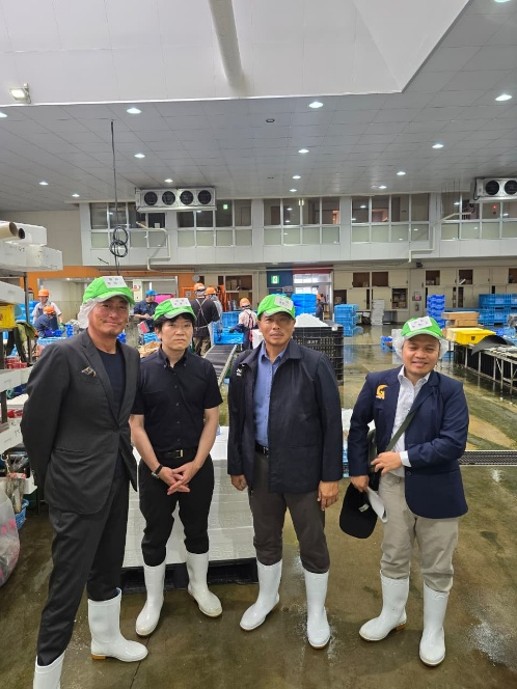
NAGASAKI, JAPAN – The Faculty of Fisheries and Marine Sciences (FPIK), Universitas Diponegoro (UNDIP), is expanding opportunities for its students to gain international professional experience through a strategic visit to Nagasaki Prefecture, Japan. Led by Prof. Dr. Agus Trianto, S.T., M.Sc., Ph.D., Dean of FPIK UNDIP and Chair of the Indonesian Forum of Higher Education Institutions for Fisheries and Marine Sciences (FKPTPK Indonesia), the visit focused on learning from Japan’s integrated fish market management system and exploring opportunities for international internship programs for FPIK UNDIP students.
The initiative is part of FPIK UNDIP’s efforts to strengthen student competencies by providing opportunities to gain first-hand experience in advanced fisheries industries while developing professional skills, international perspectives, and a strong work ethic.
Exploring Matsuura’s Fish Market: A Hub for Japan’s “Aji Furai” Industry
One of the key activities during the visit was an inspection of the Matsuura Fish Market, one of the major fisheries ports in the Kyushu region. Matsuura accounts for nearly half of Japan’s total aji (Japanese horse mackerel) catch. The local fisheries industry processes up to 200,000 pieces of aji furai—breaded and fried horse mackerel—per day.
The signature product has a strong presence in Japan’s domestic market and has also become a popular culinary attraction, while its market reach extends to export markets in the European Union.
During the visit, Prof. Agus observed first-hand the modern and highly hygienic supply chain connecting fisheries operations from harvesting to processing. The process begins at sea, where fishing vessels use ice slurry technology to maintain the freshness of the catch. Once the fish arrive at the port, they are transported through automated conveyor systems that also sort the fish according to size.
Adjacent to the market is a modern processing facility operating under EU HACCP standards. HACCP, or Hazard Analysis and Critical Control Point, is a science-based food safety management system used to identify, assess, and control potential hazards throughout the food production process.
At the processing facility, the fish are cleaned, filleted, and coated with high-quality panko breadcrumbs under highly controlled and hygienic conditions.
“From the moment the fish enter the conveyor system until they are packed, the entire process is maintained at a controlled low temperature and in a very clean environment. As a result, there is hardly any fish odor around the port. An integrated fish market model that connects the fishing port, auction market, and processing industry like this could serve as a valuable reference for Indonesia. The system is highly efficient, controlled, and hygienic,” Prof. Agus said.
Connecting Students with Japan’s Fisheries Industry
The visit went beyond benchmarking technology and fisheries management. It also carried a broader mission to create international learning and employment opportunities for FPIK UNDIP students.
Following the port visit, the delegation held an intensive discussion at the Matsuura Port complex with representatives from local fish processing and marketing companies. Industry representatives in Matsuura, Nagasaki, expressed their interest in collaboration, particularly in response to the seasonal demand for skilled and educated workers.
For FPIK UNDIP, the partnership provides an opportunity for students to gain direct exposure to modern fisheries technologies, industry practices, and professional working environments in Japan.
Building International Internship Opportunities for FPIK UNDIP Students
To strengthen the institutional framework for the proposed partnership, the delegation was also officially received at the Nagasaki City Hall. During the meeting, Prof. Agus outlined the broader vision behind FPIK UNDIP’s international internship initiative.
“An internship for fisheries and marine sciences students is not simply about gaining technical knowledge and professional experience. It is also about developing a strong work ethic, professional discipline, and a broader global perspective,” Prof. Agus explained.
The program is expected to equip FPIK UNDIP students with experience of Japanese workplace standards and international industry practices. Upon returning to Indonesia, students are expected to apply the knowledge and skills they have gained to contribute to the development of the national fisheries sector, whether through careers in government, industry, entrepreneurship, or social entrepreneurship.
The meeting concluded with a shared commitment to move forward with the internship program in the near future. The number of participating students is expected to increase gradually, based on evaluations of student performance and the needs of partner companies.
Through this strategic initiative, FPIK UNDIP aims to strengthen international exposure for its students while developing a globally competitive generation of fisheries and marine sciences professionals. The program is also expected to contribute to the achievement of UNDIP’s key performance indicators and strengthen the university’s international partnerships.
By connecting Indonesian students with Japan’s advanced fisheries industry, FPIK UNDIP continues to create pathways for students to learn beyond the classroom, gain global experience, and bring new knowledge and professional perspectives back to Indonesia.