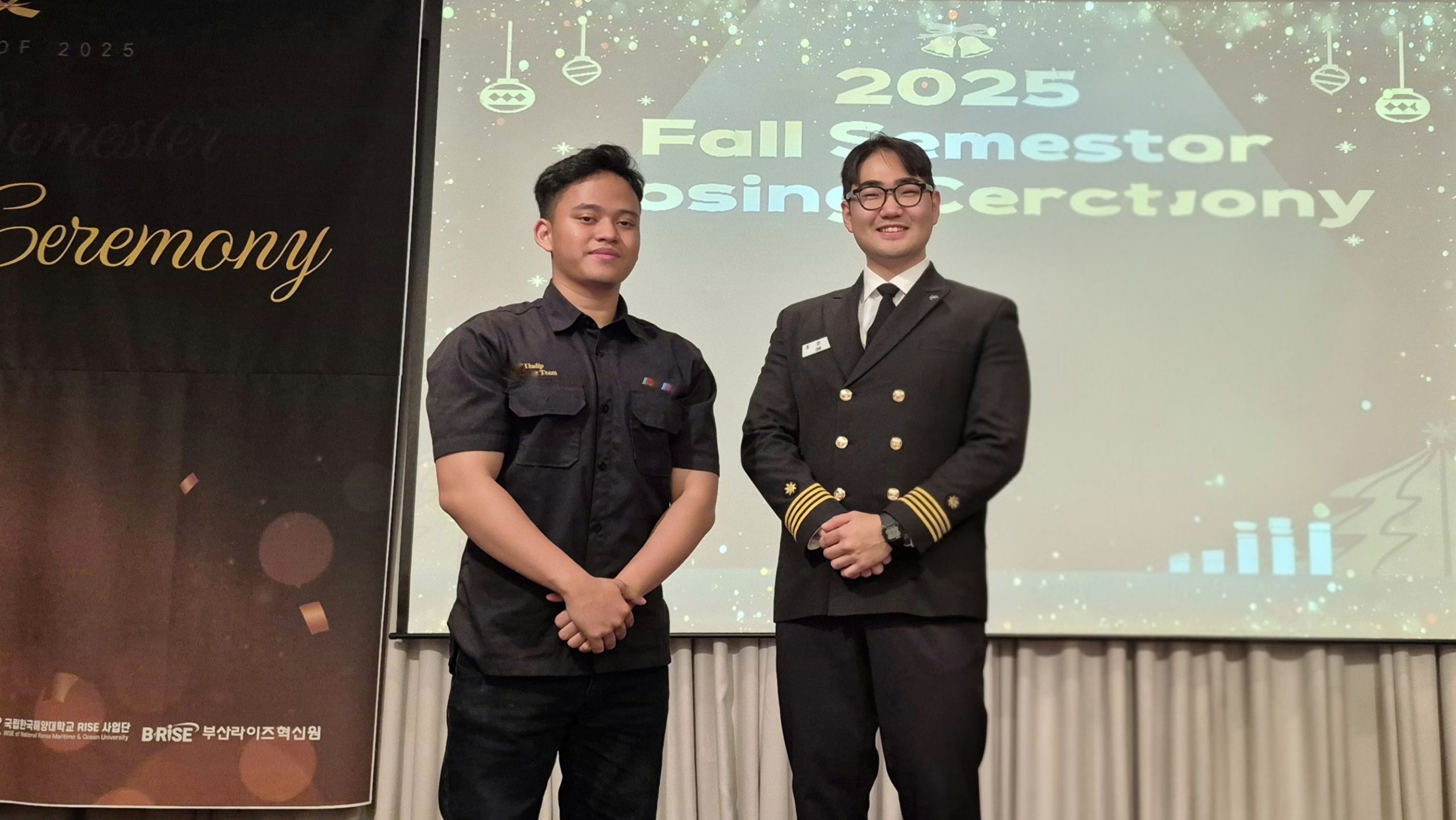
The WCU SGI (World Class University Students Go International) Program of Universitas Diponegoro is one of the university’s internationalization initiatives aimed at encouraging students to gain global academic experience. This program is implemented through the Fall Semester Student Exchange Program, hosted by the Department of Marine System Engineering, National Korea Maritime & Ocean University (KMOU), Busan, South Korea.
One of the participants in this program is Muhammad Renaldi Zhafran, a student from Tangerang Selatan enrolled in the Department of Marine Science, Faculty of Fisheries and Marine Science (FPIK), Universitas Diponegoro. Through the WCU SGI program, students are given the opportunity to engage in academic and field-based activities focusing on the development of marine science, oceanography, and global maritime studies.
During the program, Muhammad Renaldi Zhafran received a full scholarship from the Government of South Korea through the Global Korea Scholarship (GKS), which supports the one-semester student exchange program. This scholarship provides academic support and international mobility assistance, enabling the student to participate fully and optimally in all program activities.
Through the Ocean Energy Engineering course, students are equipped with both technical and visionary understanding to develop marine energy as part of the global energy transition.
The Introduction to Offshore Plant course covers the fundamental concepts of offshore facility systems, including the design, operation, and safety of offshore installations.
The LNG Ship Facilities and Practice course discusses LNG ship facility systems, including storage, handling, and safety aspects in the transportation of liquefied natural gas.
The field trip to the Hyundai Ulsan Plant provided students with the opportunity to learn about the company’s history and to directly observe the vehicle manufacturing process, from assembly lines to the shipping system that delivers Hyundai vehicles to global markets.
In addition to the core courses in marine and energy studies, students also participated in several supporting courses aimed at strengthening technical competencies and global adaptability.
Students attended the Internal Combustion Engine course, which covers the working principles, performance, and efficiency of internal combustion engines as a foundation for energy and transportation technologies.
Through the Fuel Cell System course, students studied fuel cell technology as one of the clean and sustainable energy solutions for the future.
Students also took Korean Language classes as part of enhancing cross-cultural communication skills and supporting cultural adaptation during the student exchange program in South Korea.